

A featured contribution from Leadership Perspectives: a curated forum reserved for leaders nominated by our subscribers and vetted by the Construction Tech Review Advisory Board.

CREALOGIX
Corporate Banking: A helping hand with an aggregated view of the user experience

Pascal Wengi
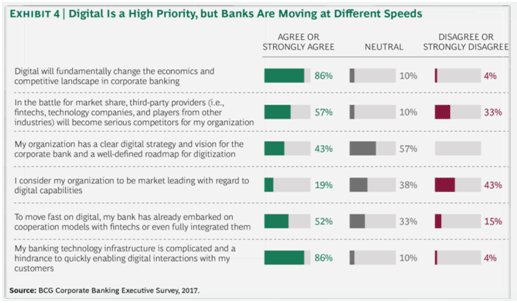
In March this year, BCG (Boston Consulting Group) published the Global Corporate Banking 2018 report. Their analysts are expecting dramatic changes in the next five years: up to 30 percent of the revenue in corporate customer banking is available and could be lost to digital platforms and channels. This danger is well-known at management level in banks. 86 percent of decision-makers surveyed by BCG agreed with the statement that digitalization will fundamentally change the competitive environment and the business model for corporate customers. The study mentions various reasons:
• Corporate customers are intensively digitalizing their operational business and expect to involve banks in their scenarios.
• There are increasingly powerful digital tools – robotics, big data, AI, blockchain – and companies are adapting their infrastructure to be able to use these.
• Digitalization is revealing its own dynamic. The more significantly the banks’ value creation chain changes, the more approaches to new business models offer themselves to new players.
• Fintechs are developing a high level of competitive pressure.
Only a fifth (19 percent) of those surveyed feel that they have comprehensively grown to address this (see graphic). “Handling the transformation is, first of all, about developing one’s own idea of how corporate customer banking will evolve and the role that one’s own institution plays in the new digital environment,” observes the report, and the authors issue a forceful warning about taking rash measures without thinking through the strategic trajectory in advance.
Digitalization is diversifying corporate banking
As in the wider banking sector,digitalization is also driving a diversification of different business models in corporate banking.
Digitalization is also driving a diversification of different business models in corporate banking
The most obvious idea is to continue to sell one’s own products and services. To be successful at this in the medium term, however, the institution must digitalize in all areas and continuously integrate innovations into its own business model – a method that the BCG report believes only a handful of institutions will be able to successfully navigate going forward.
Specialists, for example in individual sectors, could monetize access to their customer group by building a digital ecosystem and providing customers with a comprehensive range of services, extending their offering through third parties. Another option is to invest in highly efficient digital platforms into which corporate customers can incorporate a wide range of their own solutions, products from other banks and other third parties. Ultimately this can also be the best way to offer one’s own niche products on other companies’ platforms.
E-banking portal for corporate customers
Whichever path the financial institution chooses to follow, a serious game of catch-up is under way in the corporate customer sector as far as user experience is concerned. While private customers are already effortlessly clicking through carefully designed apps with their gamified banking, day-to-day work in accounting often looks dreary. The different banks’ online portals for corporate customers require individual management and files must be uploaded one at a time. There is no general overview. With a Digital Banking Hub as the technological foundation, financial institutions can develop e-banking portals for corporate customers which are multi-bank-capable and thus offer a complete overview of actual current liquidity. After all, payments are at the root of all business.
As corporate business frequently generates more revenue than private customers, it is very much worth banks asking themselves how they can support professional users. In addition to holistic, multi-bank-capable online banking with workflows and rights concepts which can be individually defined, self-administration plays a major role. It is now old-fashioned to invite the new CEO of a company to come into a branch for identification purposes. Instead, they should have the option to do this digitally in a manner that is legally sound. Different processes, such as video identification, can be incorporated into banking portals.
The market share of software providers is increasing with online banking
Banks save time when they digitalize routine processes. On the other side of the coin, it makes it easier for small and medium-sized enterprises to secure their liquidity and thus reduce costs and risk. Large companies and groups generally use software solutions for cash management. In this area, banks are now coming into play as competitors with attractive proposals: corporate customers save on software and maintenance costs and no longer need to install updates.
Against this background, it is clear that well-made portals with smart management of access rights can be successfully monetized. At the same time, they act as a door to additional revenue as, for example, factoring providers, cloud-based account solutions or even business-related software systems can be incorporated. Every financial institution needs to find its role in the digital ecosystem. The sector has only just begun to exploit the potential of open banking for corporate customers.
The articles from these contributors are based on their personal expertise and viewpoints, and do not necessarily reflect the opinions of their employers or affiliated organizations.
